 Umut CANandClaude Opus 5
6b9860e68e
The triage over the 43 unaddressed verdicts returned 4 code and 35 doc items.
The code ones shipped in e24b46d; these are the documents.

Twenty-one applied mechanically after a validation pass confirmed each locator
still matched exactly once and each replacement was supported by the tree. Ten
were held back because a re-verify pass found them mutually exclusive -- three
patches rewriting the same benchmarks/README block, three rewriting the same
OCS paragraph -- and applying them in sequence would have corrupted the files.
Those were resolved by hand into one coherent edit each. One was rejected.

The corrections worth naming:

- **The A/B table contradicted itself in three files.** benchmarks/README.md
  and CLAUDE.md said 24 checks / 21-24 / 87.5% / "fixed 3" while the suite has
  26 and the published JSON says 21/26, 80.8%, five fixed. All three now agree,
  and the five are split into the three new-capability `miss -> pass` and the
  two repaired-defect `fail -> pass`, which is the distinction the lane exists
  to make.
- **"Every number below is produced by a script"** was false twice over:
  section 5's nine scores are literals a human assigned, and section 4 now
  quotes hand-collected timings. The claim is narrowed to the charts, which
  really are all rendered from committed data, and both exceptions are named.
- **The OCS paragraph over-quantified.** TEXT rotation was given as the single
  exception; z components and HATCH boundaries are also entity-frame, and the
  live backend records `2d_polyline_coordinates_not_verified_against_live_autocad`
  in the same reason string. It now points at `ocs_normalized` as the live list.
- **Transactions were shown as bare parity.** The server itself grades them
  differently -- `FeatureCapability(True, "undo_mark")` on COM against
  `(True, "snapshot")` headless -- and COM rollback sends `_UNDO B` without
  confirming it landed. The row says so.
- **"Raw commands: Opt-in"** named a switch that does not exist. Both tools are
  registered unconditionally; `DANGEROUS_COMMANDS_ENABLED` only disables the
  sanitizer.
- **"Wave A shipped 13 of a planned 39"** hardened an approximation: the only
  source writes `~39`.
- **CAD_PROGID** said nothing beyond the connection was tested against
  BricsCAD/ZWCAD/GstarCAD, implying the connection was. It was not.

Perf lane reworked against a fresh paired measurement. The old text claimed
"28% slower than v1.4.0, median of three runs" and that
`EZDXF_CALL_TIMEOUT=0` restored v1.4.0's numbers "exactly". Three problems:
`perf_suite` runs each workload once per invocation and cannot produce a
median, "exactly" was refuted by the figures in its own sentence, and the
number moved when the timeout wrapper was rebuilt. It now reports the guard's
cost -- +20.8% and +19.9%, three paired runs, median taken by hand -- says the
figures have no published artifact, and says the wrapper rework recovered about
a third of the v1.5.0 overhead rather than closing it.

perf-ezdxf.json and the perf chart regenerated against the shipped code, and
the README table rebuilt from that artifact so the two cannot drift.

1267 passed, 1 xfailed.

Co-Authored-By: Claude Opus 5 <noreply@anthropic.com>
34 KiB
AutoCAD MCP Pro
Production-grade AutoCAD automation for AI agents. Live through COM on Windows, or headless through ezdxf on any platform — one typed contract, two engines.






Install · Evidence · Two engines · Limits · Config · Changelog
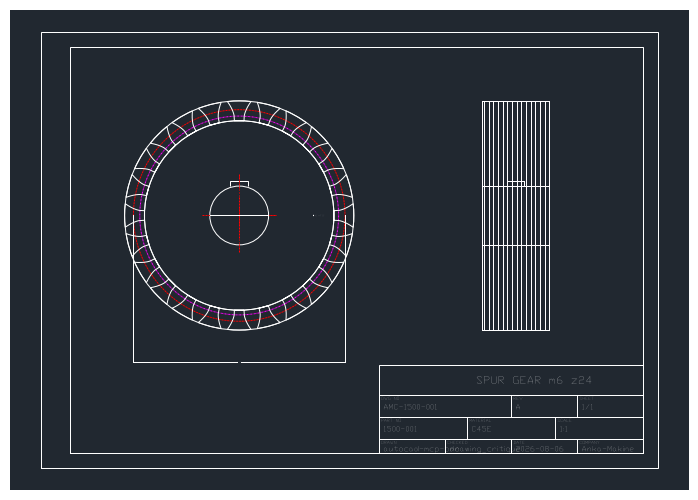
Not a mockup. Every line on this sheet was drawn by the tools this server exposes — ISO layers, involute gear geometry, DIN 6885 keyway, section A-A, ISO 129 dimensions, an ISO 286 H7 bore fit, ISO 7200 title block — then rendered headlessly by view_screenshot. drawing_critique returns 0 issues on it. Rebuild it with python scripts/render_readme_showcase.py.
v1.5 release snapshot: 154 tools · 6 resources · 5 prompt templates · 1258 collected tests. 154 is the registered count. A default install advertises 149 over
tools/list, becauseENABLE_3Dis unset and the fivesolid_*tools stay hidden.system_aboutis the runtime authority.
Why this exists
Two problems, both measured before a line was written.
A big MCP server is expensive to be connected to. The full catalog puts an estimated 40,305 tokens on the wire before the client has asked for anything, of which about 25,143 are the part a client actually forwards to the model — 149 advertised tools at ~169 tokens of name, description and input schema each. Turning on discovery replaces that catalog with two tools and 356 wire tokens.
A drafter searches for WBLOCK, not for block_create_from_entities. WBLOCK, PEDIT, OVERKILL, LAYTRANS and MATCHPROP appeared in no tool name or description, so they scored df = 0 against a stock text index — not badly ranked, absent. No amount of tuning finds a word that is not in the data, so the fix was data: an authored corpus of 158 distinct AutoCAD command names and 672 synonym phrases covering all 154 tools, layered onto the index. A test holds that df=0 list honest in both directions — it fails if one of those commands becomes findable without the corpus, and it fails if the corpus stops covering one.
| Advertised surface | Tools a client sees | tools/list on the wire |
|---|---|---|
TOOL_PROFILE=full (default) |
149 | 40,305 tokens |
TOOL_PROFILE=lean |
47 | 12,131 tokens |
DISCOVERY_MODE=search |
2 | 356 tokens |
Note
Token figures are estimates from an offline ratio counter (
ratio/v1), not tokenizer counts — characters are the measured unit and the report says so. Under prompt caching the idle term is largely amortised, so read 113× as the uncached wire ratio, not a bill.python -m benchmarks.token_suite --tokenizer anthropiccounts for real, but it needs theanthropicpackage and credentials, neither of which is in this repo's lock — it refuses rather than silently falling back.
Install in 10 seconds
pip install autocad-mcp-pro     # or: uvx autocad-mcp-pro
autocad-mcp                     # stdio MCP server, backend auto-selected
Headless anywhere, or live AutoCAD on Windows:
AUTOCAD_MCP_BACKEND=ezdxf autocad-mcp    # portable DXF engine, no AutoCAD needed
AUTOCAD_MCP_BACKEND=com   autocad-mcp    # live AutoCAD (pip install "autocad-mcp-pro[com]")
| Extra | Pulls in | For |
|---|---|---|
| (none) | fastmcp, ezdxf, pydantic |
Headless DXF on any OS — no rendering |
[com] |
pywin32, Pillow |
Live AutoCAD control + window capture |
[pdf] |
matplotlib |
PDF export and headless PNG rendering, any platform |
[full] |
everything above | Live AutoCAD and rendering in one install |
Note
The bare install cannot draw pixels.
ezdxf.addons.drawing.frontenddoes an unconditional top-levelimport PIL.Image, so Pillow is required by every ezdxf render path — PNG screenshot and PDF export alike — not just by the COM window capture it is listed under. Add[pdf](or[full]) if you want images on Linux or macOS.
From a checkout: pip install -e ".[full]" on Windows, or pip install -e ".[pdf]" elsewhere, then python server.py. ([com] and [full] carry a sys_platform == "win32" marker on pywin32, so they resolve everywhere — they simply install nothing Windows-specific off Windows.)
Wire it to a client
{
  "mcpServers": {
    "autocad": {
      "command": "autocad-mcp",
      "env": {
        "AUTOCAD_MCP_BACKEND": "auto",
        "ALLOWED_PATHS": "C:\\Users\\you\\Documents\\AutoCAD",
        "TOOL_PROFILE": "full",
        "DISCOVERY_MODE": "off"
      }
    }
  }
}
Works with Claude Desktop, Cursor, or any stdio MCP host. For HTTP: autocad-mcp --transport http --port 8000 — loopback only unless remote HTTP is explicitly enabled and a bearer token is set. The model vendor is not part of the server contract.
What you get
| Area | What it does |
|---|---|
| Drawing lifecycle | create, open, save, export DXF/PDF, audit (now repairs), purge; undo/redo live on COM and opt-in headless via EZDXF_UNDO_DEPTH |
| Geometry | lines, arcs, polylines, splines, hatches, trim/extend/fillet/chamfer, handle-preserving edits |
| Annotation | ISO 129 toleranced dimensions, ISO 286 fits (fit="H7"), TABLE, MLEADER, GD&T frames and datums (ISO 1101) |
| Engineering generators | involute gears (front + section A-A), DIN 6885 keyed bores, ISO A3 title block |
| Discovery ✨ | search_tools ranked over an AutoCAD command and synonym corpus — FILLET, BPOLY, QSELECT, WBLOCK, OVERKILL, CHSPACE each rank #1 of the 149-tool advertised catalog |
| Batching ✨ | cad_batch runs a whole step list in one round trip; fields= projects the response on 11 result-heavy tools (a closed, gated list) |
| Paper space ✨ | 8 of the 12 layout tools are new — layout_delete/rename/copy, viewport_list/set_scale/lock/delete, entity_change_space (CHSPACE, headless only); layout listing, creation and activation, viewport_create and drawing_export_pdf(layout=...) shipped in v1.4.0, which wrongly declared headless viewport rendering impossible |
| Selection ✨ | window vs crossing stated back to the caller; the polygon is tested as a shape, not as its bounding box — the entity side is still its bounding box, on both engines |
| Boundaries ✨ | boundary_trace (BOUNDARY/BPOLY) chains loose edges into one closed polyline; ARC edges keep their exact bulges, while a bulged polyline segment or any other curved edge is chained as its chord — headless engine only |
| Measurement ✨ | analysis_measure_entity measures what is in the drawing, by handle |
| Hatch depth ✨ | gradients, in-place edits and island styles on both; typed edge boundaries headless only |
| Annotation objects ✨ | WIPEOUT, REVCLOUD, MTEXT background masks — headless only, ActiveX exposes no member — plus text find/replace on both |
| 3D solids | solid_box/cylinder/extrude/revolve/boolean on live AutoCAD (ENABLE_3D=true) — unverified against a live seat: they shipped in v1.4.0, and the v1.5.0 live run covered only what that release added |
| Quality loop | drawing_preflight → drawing_plan → drawing_critique → drawing_refine → drawing_finalize (0–100 score) |
| Delivery | drawing_deliver: DXF/PDF/PNG + SHA-256 manifest + reopen-parity checks |
✨ = new in v1.5.0. 154 tools across 19 groups — entity_creation 18, entity_modification 15, layers 14, analysis 12, layouts 12, premium 12, drawing 11, engineering 10, blocks 8, entity_query 8, system 7, dimensions 5, solids 5, corner_ops 4, view 4, batch 3, transactions 3, templates 2, validation 1.
Alongside the tools, 6 MCP resources cost nothing in the tool budget and are browsable at any time — autocad://drawing/info, autocad://layers, autocad://blocks, autocad://entities/stats, autocad://entities/{layer_name}, autocad://system/status — plus 5 prompt templates (prompt_mechanical_drawing, prompt_floor_plan, prompt_electrical_schematic, prompt_pid_diagram, prompt_quick_drawing).
Two rules worth knowing before you draw
Coordinates come out in WCS, and the exceptions are declared rather than hidden. DXF stores CIRCLE / ARC / LWPOLYLINE / TEXT / INSERT geometry in a per-entity frame, and before v1.5.0 the word extrusion appeared nowhere in this codebase, so a mirrored or rotated entity reported coordinates that were quietly wrong. An entity in a plane tilted out of WCS XY now reports plane_normal and omits the fields xy cannot express, rather than answering with a number that looks fine.
Three things stay in the entity frame on purpose, and system_capabilities' ocs_normalized reason string is the live list: TEXT rotation (a mirrored TEXT is mirror-imaged, and no single scalar angle expresses that), z components, and HATCH boundary geometry. On the live backend that same reason string also records 2d_polyline_coordinates_not_verified_against_live_autocad — read it at runtime rather than trusting this paragraph.
Never read vertices back and shoelace them. That loses 28.2% of the area on a semicircular edge, silently. analysis_measure_entity(handle) reads the real geometry and states its own accuracy: exact, flatten_tolerance, assumed_closed, self_intersecting.
The two engines
One contract, split across 19 modules in backends/contracts/. Most are ABCs; gdt.py and settings.py are concrete shared mixins rather than interfaces. Optional methods are declarative — @capability(key, reason=...) supplies a default that refuses — and a test holds the two backends' capability key sets equal, so a key cannot exist on one engine and be forgotten on the other.
There are 27 capability keys. system_capabilities returns the live map, and you should read it at runtime rather than trusting the table below, because five of the 27 depend on how the machine is set up:
| Capability | COM (live AutoCAD) | ezdxf (headless) |
|---|---|---|
| Live document control | ✅ | — |
| Cross-platform, no AutoCAD | — | ✅ |
| Transactions and rollback | ✅ undo mark; rollback sends _UNDO B and AutoCAD never confirms it landed — best-effort, not atomic |
✅ full DXF snapshot, restored synchronously |
| Paper-space layouts + viewports | ✅ | ✅ |
| Viewport model-content rendering | ✅ | ✅ ᵐ (no viewport borders) |
| Selection window / crossing / polygon | ✅ | ✅ |
| Entity area by handle | ActiveX .Area |
Analytic, bulges included |
| HATCH filled area (islands subtracted) | AutoCAD's own number | Loops walked, hatch_style reported |
| REGION / 3DSOLID area | ✅ | — ACIS is opaque to ezdxf |
| 3D solids | ✅ only with ENABLE_3D=true |
— no headless ACIS |
| DWG write | ✅ | — no DWG writer |
| WIPEOUT | — AddWipeout verified absent, AutoCAD 2026 |
✅ |
| MTEXT background colour | — BackgroundFillColor verified absent, AutoCAD 2026 |
✅ |
| REVCLOUD, BPOLY / boundary tracing | — no ActiveX member; command-line only | ✅ |
CHSPACE (entity_change_space) |
— unverified against a live seat | ✅ ᶜ |
| Undo history | ✅ | opt-in — EZDXF_UNDO_DEPTH defaults to 0 |
| TABLE and MLEADER | Native | Portable composite |
| Raw commands / AutoLISP | ✅ on by default, denylist-sanitized — DANGEROUS_COMMANDS_ENABLED=true removes the denylist |
— no live command line |
| Screenshots and PDF export | AutoCAD window capture | Matplotlib render ᵐ |
ᵐ Needs matplotlib — the [pdf] or [full] extra. Without it png, pdf, viewport_render and handle_overlay all report unsupported on the headless engine.
ᶜ The headless CHSPACE carries four named restrictions in its own capability reason: top-view untwisted viewports only, dimensions refused unless frozen, ACIS/proxy/table refused, and viewport clipping reported rather than applied.
Important
The COM paths added in v1.5.0 were executed against a live AutoCAD 2026 before release — two documented exceptions aside: the
AcDbLWPolylineOCS→WCS translation inentity_getand the COM half ofblock_create_from_entitiesship unit-tested against a fake ActiveX object, not hardware-verified. The live run was 25 calls: 18 succeeded, 1 refused a specific argument, and 6 refused with the capability keys they declare. That run found four defects, three of which no amount of reading would have caught (the fourth wasanalysis_list_propertiescalling a helper that does not exist onComBackend) — the largest being thatAcadPViewporthas noViewCentermember, so the line setting it had been silently swallowed by a bareexceptsince v1.4.
Evidence
Every chart below is rendered to SVG by Python from committed data — none is hand-edited. The numbers are not all script output, and the two exceptions are marked where they appear: section 4 quotes timings collected by hand across separate runs, and section 5 is a hand-assigned source review whose nine scores are literals in source_review.json that the renderer validates and draws but does not compute.
1 · Live-run scores

| Server | Matrix | Pinned | Score | Pass |
|---|---|---|---|---|
| autocad-mcp-pro (this repo) | v3 · 15 tasks | working tree | 100.0 | 15/15 |
| beiming183-cloud/AutoCAD-MCP | v2 · 10 tasks | 11f7c47 |
50.0 | 5/10 |
| puran-water/autocad-mcp | v2 · 10 tasks | 95476a3 |
45.0 | 4/10 |
Warning
Read the matrix column before the score column. The five v3 tasks are new in v1.5.0; the competitor runs are from 2026-07-23 against pinned competitor commits, and were never put to them. Their scores are over the ten tasks they actually ran, and the five new rows render blank rather than as zeros — an invented zero is indistinguishable from a measured one. These bars do not share a denominator, which is why each one carries its matrix.
Competitors are driven black-box over MCP stdio against the tool contracts read from their pinned source, at 50% coverage on both: five of the ten tasks per competitor are recorded unsupported — the operation is absent from that checkout, or refused by it — and those rows score zero against a denominator of ten, so 50.0 and 45.0 are coverage-weighted, not ten measured attempts. Over the tasks actually driven, beiming scores 100.0 and puran-water 90.0. Where a task does run, every geometry claim the competitor makes is re-derived by re-opening the exported DXF with ezdxf inside the harness — their own tool output is never the source of truth. This repo's row is not run that way: it runs in-process against the backend, and 13 of its 15 tasks assert on backend return values rather than on a re-opened DXF (only dxf_roundtrip and auditable_delivery write a file at all). What is independent there is the expected value — a closed-form area, entities placed on purpose, a token ceiling fixed before the measurement — not the observation. A capability refusal is recorded unsupported, not fail — "cannot reach this" and "got this wrong" are different findings. That classification is written into the adapter from the competitor's pinned source; a refusal that only appears at runtime becomes unsupported where the adapter recognises it (beiming's E_UNSUPPORTED on transaction begin is the one that did) and lands as fail otherwise.
2 · Task matrix — where the score comes from

v2 scored this repo 10/10, and that number carried no information: every task in it exercised something the server was built around. v3 adds five tasks chosen because they can fail — and two of them did, while being written: hatch_islands (a HATCH could not be measured at all) and measure_from_handle (the boundary tools and the measurement tool disagreed about the same shape). A third measurement defect fixed in the same release — a circle stored as two bulged vertices measured 0.0 — is carried by two_vertex_circle_has_area in the correctness suite, not by a benchmark task.
| v3 task | Verified against |
|---|---|
tool_discovery |
six AutoCAD command names, each ranking #1 of the 149-tool advertised catalog |
token_budget |
40,305 → 356 tokens advertised, against a 2,000 ceiling fixed in advance |
hatch_islands |
300 filled with the island, 400 ignoring it |
selection_filter |
window 1, crossing 2, bounding box 3, polygon 1 |
measure_from_handle |
139.2699 against the 100.0 a vertex shoelace gives |
3 · Correctness A/B — every release re-proves itself
26 deterministic headless checks against the previous tag and the current tree, each in its own subprocess so a hard crash counts as a miss rather than killing the run.
| Version | Checks passing | Pass rate | Fixed | Regressed |
|---|---|---|---|---|
| v1.4.0 (baseline) | 21 / 26 | 80.8 % ᵃ | — | — |
| v1.5.0 (this release) | 26 / 26 | 100 % | 5 | 0 |
ᵃ Against the 26-check v1.5.0 suite. v1.4.0 passed 21/21 of the checks that existed when it shipped.
The five splits into two kinds, and the difference matters:
- Three are new capability, not repaired regressions. v1.4.0 has no
entity_measureand no boundary tracing, so it misseshatch_area_subtracts_its_island,boundary_area_agrees_with_measureandtwo_vertex_circle_has_areaby not having the method. - Two are real defects that v1.4.0 shipped. It has
dimension_diameteranddimension_radius, and both returned the wrong number:leader_length— a text placement — was being measured as geometry, so at default settings every diameter callout came out 2 × leader_length too large (60 on a true ⌀40) and every radiusleader_lengthtoo large. Found while building the drawing at the top of this page. The live COM backend was never affected.
The 21 pre-existing checks are unchanged and all still pass: the discovery layer, cad_batch, the 19-module contract split, layouts/viewports and Wave A landed with zero correctness regressions.
4 · Headless performance

| Workload | Wall time | Result |
|---|---|---|
| Create 2,000 lines (individual calls) | 0.35 s | ~5,716 entities/s |
| 10,000 lines: build + DXF export + reopen | 2.18 s | ~4,591 entities/s end-to-end |
| Region query over 10,000 entities | 2.47 s | 2,500 matched |
| Premium pass (layers + part + dims + full critique) | 0.26 s | 0 issues |
One run of each workload — perf_suite executes each exactly once per invocation, and these are the figures in the committed perf-ezdxf.json. Run-to-run spread on this machine is wide enough to matter: treat them as an order of magnitude, not a stopwatch.
Workloads call the same backend methods the MCP tools call, so the backend's own per-call overhead — worker-thread hand-off, document lock, the EZDXF_CALL_TIMEOUT guard — is included. The FastMCP layer above it is not: perf_suite.py never builds the server, so tool dispatch, argument validation, the five middleware and result serialization all sit outside the timer, and in-process they cost roughly an order of magnitude more than the backend call itself. Read these as backend-engine numbers, not per-tool-call latency. Self-measurement only — competitor servers pay an extra stdio serialization cost that in-process runs do not, so no cross-server timing claims are made.
Caution
These are not an improvement over v1.4.0, and they are not the engine's floor. The per-call timeout guard costs about 21% of entity-creation throughput — see what this release is bad at for the paired measurement and why the guard is kept.
5 · Source-review leaderboard

Nine public AutoCAD MCP projects against a fixed 100-point rubric — CAD breadth (25), correctness and delivery (20), backends/platforms (15), engineering production (15), tests and maintenance (15), security and operations (10). Stars and raw tool counts score nothing. Data and dates in benchmarks/source_review.json.
This table is not re-scored per release — no row is, including the other eight. This repository's row is still the one written against v1.4.0. Raising our own number for v1.5.0 would mean re-reviewing eight other projects the same day to keep it fair, and that has not been done — so the score stays where the evidence is.
Method, caveats and boundaries for every lane: benchmarks/README.md.
What this release is bad at
A page that only lists strengths is a page that has not been measured.
Entity creation is ~21% slower than it would be without the call timeout.
The timeout is what stops one hung ezdxf call wedging a server whose document
lock is a single asyncio.Lock, and it is not free. Measured on one
interpreter, three runs of each configuration with the median taken by hand
(perf_suite runs each workload once per invocation — it cannot produce a
median itself):
| Workload | EZDXF_CALL_TIMEOUT=0 |
default (120 s) | Cost |
|---|---|---|---|
| 2,000 lines | 243.7 ms | 294.3 ms | +20.8% |
| 10,000-line roundtrip | 1,709.6 ms | 2,049.2 ms | +19.9% |
v1.5.0 paid 28.6% on the first workload; v1.5.1 rebuilt the wrapper around a
single asyncio.timeout_at instead of two asyncio.wait_fors — wait_for
wraps its awaitable in a Task, so the old shape created two extra Tasks and two
timer handles on every call. That recovered about a third of the overhead and
fixed a latent double-release, but it did not close the gap: the remaining cost
is the Task the abandon-on-timeout design genuinely needs. The knob is
documented rather than hidden, and the item stays open.
These figures are hand-collected across separate single-shot runs and have no published artifact;
benchmarks/results/published/perf-ezdxf.jsonrecords one default-configuration run only.
The README on
mainthrough the v1.4 era printed slower numbers than the table above — 0.64 s and 13.9 s for the same two workloads. That looks like a 2–6× win and is not one: the old report was recorded on CPython 3.14 and this one on 3.11.15. Almost entirely the interpreter, not code — run on one interpreter, this release is slower than v1.4.0 on both workloads, not faster. Comparing the two published files directly is the mistake this paragraph exists to stop.
Wave A shipped 13 tools of a planned ~39. Every cut is backed by a measurement. The REGION and 2D-boolean family went because add_region() produces a REGION with zero ACIS bytes, and the substitute, greiner_hormann, takes and returns flat vertex lists, so a bulged edge goes in as its chord: 28.2% of the area on a square with one semicircular edge — shipping it would have re-created the exact class of silent error this release's honesty pass exists to delete. Of the planned measurement family only analysis_measure_entity shipped — measuring a drawn entity by handle, which neither backend could do — and the centroid and moment-of-inertia tools were cut with nothing replacing them. Of the eight analysis_* tools that already existed, the two tagged measure both measured points the caller typed in.
system_run_command / system_run_lisp are a guardrail, not a security boundary — the rejection message clients receive says so in those words. A 36-verb command denylist and a 24-pattern AutoLISP denylist refuse the obviously destructive cases, but AutoCAD accepts hundreds of commands and any loaded ARX/LISP adds more, so the list cannot be complete, and DANGEROUS_COMMANDS_ENABLED=true switches both off entirely.
Path validation is per-tool, and unscoped until you scope it. Nine tools call validate_path; nothing in the middleware enforces it server-wide. With ALLOWED_PATHS empty — the default — the only positive bound is a ten-entry system-directory denylist that does not include C:/Users, /home, /root or /var. Set ALLOWED_PATHS. It is the setting that actually scopes the filesystem.
Non-AutoCAD ProgIDs are unverified. CAD_PROGID changes which COM application the backend attaches to — the configured ProgID is used at both GetActiveObject and Dispatch, and an unrecognised one fails loudly rather than falling back to AutoCAD. Nothing has been tested against BricsCAD, ZWCAD or GstarCAD, the connection included: no running seat of any of them was ever attached to. They are listed in .env.example commented out and marked UNVERIFIED.
Configuration
Nothing here loads a .env file — there is no dotenv dependency. Export these, or set them in your MCP client's env block. .env.example is documentation, and it is not the full list.
All 16 environment variables
| Variable | Default | Purpose |
|---|---|---|
AUTOCAD_MCP_BACKEND |
auto |
auto, com, or ezdxf |
CAD_PROGID |
AutoCAD.Application |
COM ProgID the live backend attaches to (unverified for clones) |
TOOL_PROFILE |
full |
lean (47 curated tools) or full |
DISCOVERY_MODE |
off |
search replaces the catalog with search_tools + call_tool |
ENABLE_3D |
false |
Expose the opt-in solid_* tools (COM backend) |
LOG_LEVEL |
INFO |
Python logging level |
ALLOWED_PATHS |
(empty) | Comma-separated absolute paths the server may access |
MAX_UNDO_STACK |
5 |
Maximum retained undo snapshots |
EZDXF_UNDO_DEPTH |
0 |
Headless undo history depth; 0 disables it |
MAX_DXF_BYTES |
52428800 |
Reject larger DXF input; 0 disables |
MAX_LIST_LIMIT |
5000 |
Bound list/selection response sizes |
COM_CALL_TIMEOUT |
60 |
Per-call live AutoCAD timeout (seconds); 0 disables |
EZDXF_CALL_TIMEOUT |
120 |
Per-call headless timeout (seconds); 0 disables |
DANGEROUS_COMMANDS_ENABLED |
false |
Allow blocked commands/LISP; reported as unsafe mode |
ALLOW_REMOTE_HTTP |
false |
Permit a non-loopback HTTP bind |
MCP_AUTH_TOKEN |
(empty) | Bearer token required for remote HTTP |
Architecture
flowchart LR
  A[MCP host / AI agent] --> B[FastMCP 3 server]
  B --> C[Error · audit · timing · logging middleware]
  C --> D[Typed contract · 19 modules · 27 capabilities]
  D --> E[COM backend<br/>single-STA thread]
  D --> F[ezdxf backend<br/>asyncio.to_thread]
  E --> G[Live AutoCAD]
  F --> H[Headless DXF]
  E --> I[Engineering · critique · scoring · delivery]
  F --> I
| Path | Role |
|---|---|
server.py |
FastMCP surface, lifespan, middleware, resources, prompts |
backends/contracts/ |
The typed contract, one module per domain |
backends/capability.py |
Capability model, typed refusals, @capability |
backends/ocs.py |
OCS ↔ WCS translation at the backend boundary |
backends/com_backend.py |
Single-STA-thread COM executor with per-call timeouts |
backends/ezdxf_backend.py |
asyncio.to_thread-wrapped DXF engine, snapshot transactions |
discovery/ |
Alias corpus, ranking transform, compact serializer |
engineering/ |
Standards, generators, critique, fits, scoring, delivery |
security.py |
Path validation, command and AutoLISP sanitization |
The drawing at the top of this page, as tool calls
Not pseudocode — this is the sequence in scripts/render_readme_showcase.py, which produced the sheet in the hero image:
drawing_new()                                    fresh document, ISO linetypes + layers bootstrapped
drawing_apply_iso_layers("mech")                 ISO 128 lineweights per layer
drawing_settings({units: "mm", linear_precision: 2})

gear_draw_spur_front_view(                       involute flanks, not a decorated circle
    module=6, teeth=24, center=[135, 172],
    bore_diameter=40, keyway_width=12, keyway_depth=3.3)
gear_draw_section_aa(x_offset=300, face_width=46)

dimension_linear(...)                            ISO 129
dimension_diameter(..., fit="H7")                deviations from authored ISO 286 tables
titleblock_apply_iso_a3(title="SPUR GEAR m6 z24", material="C45E", ...)

drawing_critique(focus=None)                     -> []  must be empty before finalize
view_screenshot()                                -> PNG
The full production loop adds drawing_preflight and drawing_plan at the front (the plan is held by the backend and replayed by drawing_critique at finalize time), drawing_refine after the critique, and layout_create + viewport_create + drawing_deliver at the end for a hashed, reopen-verified handoff.
Development
uv.lock pins the whole transitive graph — runtime and dev tools — so this reproduces CI exactly rather than approximately:
uv sync --locked --all-extras
uv run pytest
uv run ruff check . && uv run ruff format --check .
CI runs on Linux (3.11 / 3.12), Windows (mocked-COM suite), plus package, Docker and MCP-registry-schema jobs. The package job deliberately stays unlocked — it is the one that proves a plain pip install autocad-mcp-pro still resolves. A scheduled deps-floating workflow resolves the ranges fresh and re-runs the suite, so a locked CI does not become blindness to upstream drift. Releases are tag-driven: git tag vX.Y.Z && git push origin vX.Y.Z.
Roadmap (1.6)
Give back the 25% creation throughput the per-call timeout costs — arm it only for calls that can actually block. ISO 286 interference shafts r/s/t/u (they need sub-stepped table data nothing in the module can derive; 1.5 refuses them by name instead of guessing). HATCH boundary geometry in entity_get — 1.5 measures a hatch's filled area but still does not hand back its loops. REGION/3DSOLID area headlessly, which needs a modelling kernel ezdxf does not have. An allowlist of permitted AutoLISP heads, replacing the denylist — enumerating dangerous symbols does not terminate. ezdxf.recover as a fallback on drawing_open.
Features are published when their contracts and limitations are testable — not when they make a longer checklist.
Star history
If this saved you a day of drafting, a star helps other engineers find it.
Contributing
Pull requests are welcome — especially reproducible competitor adapters, mocked/live COM coverage, engineering standards, and backend parity. For a large change, open an issue first so the tool contract and evidence plan can be agreed before implementation.
Author
Umutcan Edizsalan · Mechanical engineering work at Anka-Makine · GitHub @U-C4N
Built from production drawing work, then made model-agnostic through MCP.
License
mcp-name: io.github.u-c4n/autocad-mcp